
Example: Buyer asks AI who to consider
Buyer Question
What is the best project management software options for marketing agencies?
AI Recommendation
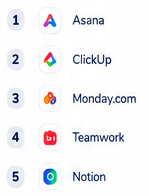
Why these competitors appear
Strong presence in trusted sources
Clear category positioning
Relevant to the buyer’s use case
Repeated positive context
Easier for AI to explain and justify
Your company
Known, but not put forward
Your company is recognised by AI but not presented as a credible option. The buyer may therefore have no reason to search for your website or investigate you further.
Clear category fit
AI can more easily understand what the company does, where it fits and when it is relevant.
Stronger proof
The company has clearer evidence across its own website and trusted external sources.
Shortlist-ready positioning
Its offer is explained in language that helps AI connect it to a buyer’s need.
Consistent market support
Similar claims, proof and positioning appear across multiple credible sources.
Stronger source signals
Competitors may appear in more recognisable sources that explain what they do, who they serve and why they are credible.
What this may mean
AI may have more visible and repeated evidence to understand, explain and introduce the competitor to buyers.
Clearer category position
Competitors may be more strongly associated with the category buyers use when searching for providers.
Best project management software for agencies
Top CRM consultants for manufacturing firms
Specialist compliance platform for marketing teams
AI visibility tools for B2B brands
What this may mean
A clearly defined category position may help AI recognise when the company is relevant and who should consider it.
Stronger use-case fit
Competitors may appear more relevant to the buyer’s specific situation, industry or need.
| Use Case | Recommended |
|---|---|
| Marketing agencies | |
| Mid-market teams | |
| Enterprise organisations | |
| Remote-first teams |
What this may mean
AI may have clearer reasons to connect the competitor to specific buyer needs and put it forward.
Repeated positioning patterns
Competitors may be described using the same strengths and claims across multiple sources.
Ease of use
Enterprise-ready
Popular with mid-market
Well suited to regulated sectors
Implementation support
Best for fast-growing teams
What this may mean
Consistent language may make it easier for AI to understand what the company does and explain why it belongs in the answer.
More visible third-party validation
Competitors may have stronger external proof across trusted sources, reviews, comparisons and industry coverage.
What this may mean
Trusted external support may make the competitor easier for AI to recognise, explain and present as credible.
Competitor displacement
Sometimes your company is not simply absent. A competitor appears instead at the buyer moment that matters.
| Buyer Journey | You | Competitors |
|---|---|---|
| Broad discovery | Appears briefly | Mentioned |
| Shortlist question | Missing | Recommended |
| Comparison question | Missing | Recommended |
| Alternative question | Present | Safer option |
| Use-case question | Weaker fit | More suitable |
What this may mean
The commercial risk is not only losing shortlist position. The buyer may be shown another company without ever being introduced to yours.
Search engines usually present links that buyers can explore.
AI-generated answers may present only a small number of providers and explain which appear most suitable.
This is why Answer Index is not an SEO audit.
Search visibility shows whether buyers can find you when they are already looking. Answer Index examines whether AI gives them a reason to look for you in the first place.
Search Visibility
AI Recommendation Presence
The commercial question is not only:
“Can buyers find us?”
It is also:
“Does AI introduce us as a company worth finding?”
Answer Index is built for these questions.
It examines recurring recommendation patterns and provides a commercial interpretation of whether buyers are being introduced to your company—or being directed elsewhere.
| Pattern | What It Reveals |
|---|---|
|
Competitor frequency
|
Which companies appear repeatedly. |
|
Buyer-stage presence
|
Where the company appears, disappears or is put forward as questions move from exploration to comparison. |
|
Comparison presence
|
Who remains visible when buyers compare final options. |
|
Source and evidence support
|
Which sources, proof points and recurring signals appear alongside competitor inclusion. |
|
Category ownership
|
Which companies appear most clearly linked to the market. |
|
Positioning language
|
Which claims and messages AI repeatedly uses. |
|
Use-case fit
|
Which companies appear relevant to specific buyer situations. |
|
Discovery gaps
|
Where your company disappears and buyers may no longer be given a reason to look for it. |
|
Competitor replacement
|
Where another company is introduced or recommended instead of yours. |
The analysis identifies recurring patterns and explains what the available evidence may indicate about why some companies are easier for AI to introduce and recommend.
The aim is not to claim exact causation.
The analysis identifies recurring patterns and explains what the evidence may indicate commercially.
Leadership teams need to understand
What not to do first
Start by understanding whether AI gives buyers a reason to discover your company.
The AI Recommendation Analysis shows where your company appears, where it disappears, which competitors are put forward instead and what recurring patterns may be shaping that outcome.
Are buyers being introduced to your competitors without ever discovering your company?
Search visibility shows whether buyers can find you when they are already looking. Answer Index examines whether AI gives them a reason to look for you in the first place.